The Strip gets photographed into the ground. Every influencer, every tourist, every phone camera in a five-mile radius is pointed at the same fountain, the same neon arch, the same luxury hotel entrance. If you want images that actually feel like yours — something beyond the postcard stack — you have to be willing to drive a few miles, wake up early, and look for the Las Vegas that doesn’t make it onto the convention center brochures.
These seven hidden Las Vegas photography spots do exactly that. Some are free. Some need advance booking. All of them reward preparation over luck — I’ll give you the actual logistics on timing, fees, camera policies, and what focal length to bring to each one.
The Neon Boneyard at the Neon Museum
No single spot in Las Vegas is more photogenic for a working photographer than the Neon Museum’s outdoor Boneyard. Retired signs from casinos, motels, and restaurants that defined mid-century Vegas are stacked together under an open sky — some still glowing, some crumbling in the most photogenic way possible. The scale surprises first-timers every time. Some of these signs are bigger than a single-story house, and you can get close enough to fill a frame with peeling paint and cracked neon tubing.
Camera policy — read before you go: During standard museum visits, personal cameras and tripods stay in the bag. The museum limits guests to phone snapshots during regular hours. If you want full gear access, book a dedicated Photo Walk or Portrait Hour through the Neon Museum website. These sessions are designed specifically for photographers and include gear access and time to actually work the space.
For portraits, a fast 35mm or 50mm at dusk handles the neon bokeh in a way nothing else does. Wide-angle shooters can treat the density of the Boneyard itself as the composition — layer sign behind sign and let the depth do the work. Budget more time than you think you’ll need here. Most photographers end up staying twice as long as planned.
Valley of Fire State Park
About 58 miles northeast of the Strip — a 55- to 65-minute drive — Valley of Fire is Nevada’s oldest state park and one of the most visually dramatic landscapes within reach of Las Vegas for a day trip. Red Aztec sandstone formations, ancient petroglyphs, and the Fire Wave trail’s swirling bands of red and white rock make this one of the most reliable sunrise locations in the Southwest.
Fees and reservations: Day use runs $10 for Nevada vehicles, $15 for out-of-state. From mid-April through mid-October, timed entry reservations may be required before 10:30 a.m. — check the Nevada State Parks site before making the drive out.
Arrive before the gate opens on weekends. The sandstone at first light picks up a warm glow that looks almost artificially lit — you don’t have to do anything clever with your camera for it to work. Crowds build fast once the sun is up. Work low, use the rock formations as leading lines, and put a person in the frame for scale. These formations are considerably larger than photos suggest, and a figure in the foreground makes that obvious immediately. For a sense of what great desert light does for a landscape session, see Wayne’s Las Vegas landscape photography gallery.
Red Rock Canyon National Conservation Area
Only 17 miles west of the Strip — about a 25-minute drive — Red Rock Canyon is arguably the most accessible dramatic landscape near Las Vegas and one of the most underused by photographers. The Calico Hills section has vivid rust and cream sandstone that goes electric at sunrise. The 13-mile Scenic Drive loops through formations that shift shape and color as you move, giving you dozens of distinct compositions in a single morning without hiking more than a few hundred yards from your car.
Fees: $20 per vehicle as of 2026 (America the Beautiful annual pass accepted). The Scenic Drive opens at 6 a.m. year-round, with closing time shifting by season — as late as 8 p.m. in summer, as early as 5 p.m. in winter. From October 1 through May 31, timed entry reservations are required for vehicle entry between 8 a.m. and 5 p.m. (book at recreation.gov); no reservation is needed June through September. Arrive at opening for the first-light window before parking fills on weekends. The Calico Hills are the strongest sunrise target in the park. High Point Overlook delivers the widest valley view for golden-hour work later in the day.
A wide zoom handles both tight canyon detail and full valley panoramas. If you’re planning portrait work with desert backdrops, Red Rock Canyon is one of the strongest options near the city. Check Las Vegas senior and portrait session locations for a fuller breakdown of spots organized by session type.
Springs Preserve
Three miles west of downtown, Springs Preserve sits on 180 acres that feel nothing like the city surrounding them. Botanical gardens, desert wetland trails, and open paths through genuinely calm terrain. It’s a strong choice for nature-leaning portraits, lifestyle shots with a desert-garden feel, and close botanical detail work — the kind of imagery that reads “lush desert oasis” rather than “resort hotel.”
Hours: Thursday through Monday, 9 a.m. to 4 p.m., last entry at 3 p.m. Closed Tuesdays and Wednesdays. Book tickets online in advance on weekends. Drones are not permitted without advance written approval from the property.
An 85mm equivalent is the right lens here — it compresses garden backgrounds, isolates subjects cleanly, and handles the butterfly habitat (active in spring and fall) without making the frame feel cluttered. Arriving right at 9 a.m. gives you the best light and the fewest people in your path.
Seven Magic Mountains
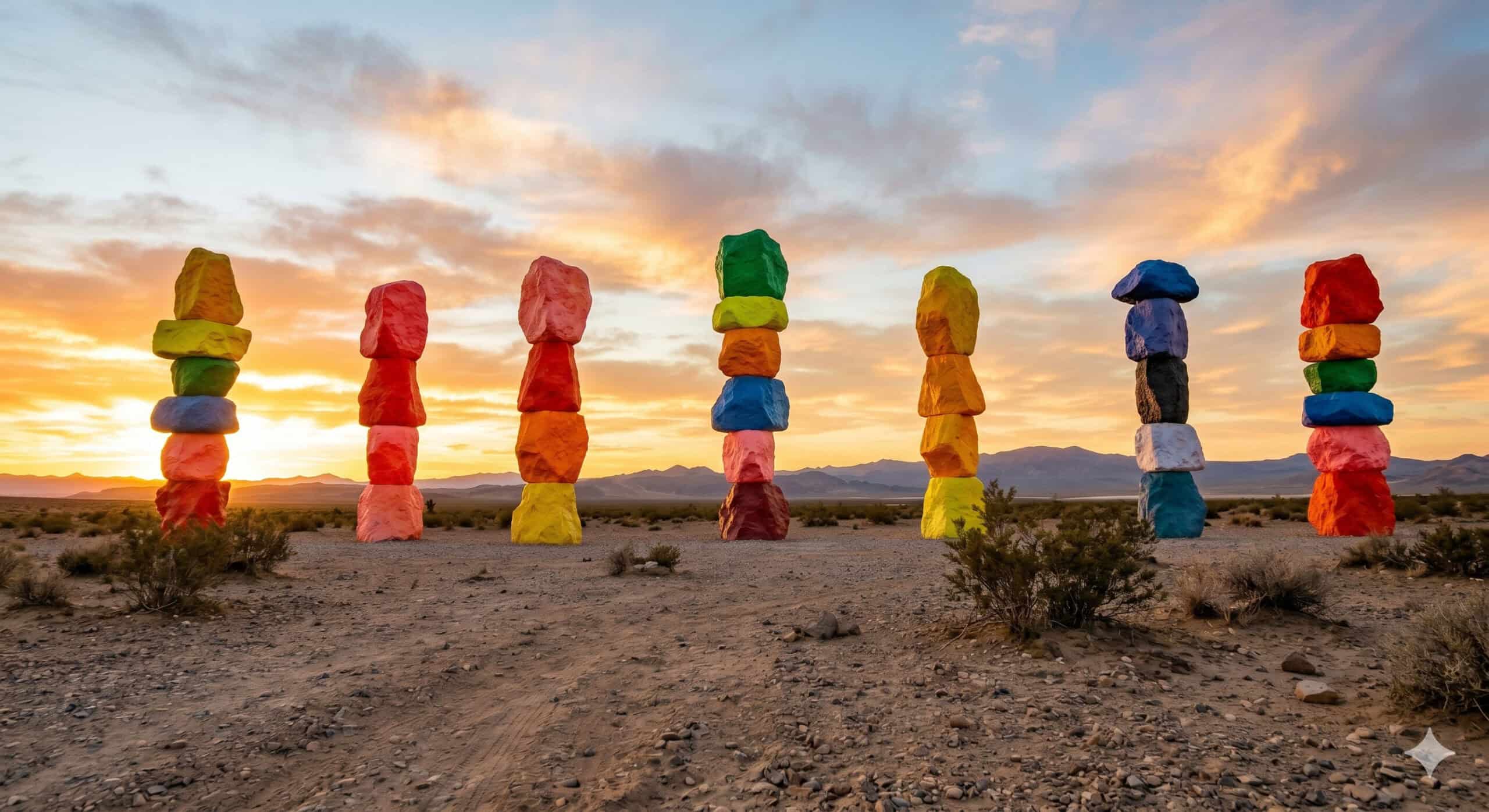
Ten miles south of the Strip, just off I-15 near Jean, Nevada, Seven Magic Mountains is a free, publicly accessible art installation that stops people cold the first time they see it. Swiss-American artist Ugo Rondinone stacked painted boulders — bright, saturated colors stacked in configurations that shouldn’t logically hold together — into seven towering columns rising out of flat, muted desert. The contrast between those neon colors and the scrubland surrounding them is as striking in person as it looks in photographs.
No ticket. No reservation. Park at the signed lot off I-15 and walk up. Worth noting: the installation’s land lease with the Bureau of Land Management runs through December 2026, so its future at this site isn’t guaranteed — see it while it’s still standing.
Every focal length finds something useful here. Go wide for the relationship between the columns and the big open sky — minimize foreground and push the stacks against the horizon. Get low and close with a wide lens and the stacks become genuinely monumental. A longer lens compresses all seven columns into overlapping color patterns that a wide shot can’t show. Sunrise is the strongest window — softer light, warmer rendering on the paint colors, and almost no one else there. One firm rule: do not climb the artwork. The installation has taken real damage from people who ignored that, and it ruins the scene for every photographer who comes after.
Downtown Container Park
Container Park in downtown Las Vegas is a shopping and entertainment complex built from repurposed shipping containers, and it photographs considerably better than the description suggests. The containers create strong geometric lines and repeating structural patterns. At night, the venue picks up a warm glow that works for both motion-blur street photography and environmental portraits with real atmosphere.
The Mantis fire show and drum circle runs on select evenings at sunset — worth timing your visit around it if you want dramatic lit subjects or a street-level event to shoot. The Deuce bus connects directly from the Strip to the Fremont area if parking is a hassle.
For portraits, use the container corridors as natural frames: depth, layers, and structure happen automatically without much compositional effort. Shop window reflections give you doubles and abstractions if you slow down and look for them. A tripod and a slow shutter — 1/15 to 1/4 second — can produce interesting crowd-motion work at night if you want something beyond standard portraits.
The Las Vegas Arts District and Its Murals
The 18b Arts District in downtown Las Vegas covers a walkable grid of blocks where murals fill building walls, alley fences, and parking structures. Some are large-scale productions tied to the Life is Beautiful festival; others are smaller pieces you stumble across while looking for something else. The whole area functions as a rotating outdoor gallery — and it costs nothing to spend a full morning here working it on foot.
The practical approach is a slow mural crawl. Match your subject’s outfit color to a background wall, or lean into contrast when the colors clash interestingly. Mix wide environmental portraits with tight crop details — paint texture, drips, lettering, brushwork. The City of Las Vegas publishes a public art walking tour map (PDF) that provides a structured starting route if you’d rather have direction than wander.
First Friday — the first Friday of each month — turns the Arts District into a full street event with vendors, artists, and a crowd filling every block. Ideal for documentary-style photography and candid portraits in a naturally lit, lively environment. If you want professional portrait results from any of these locations rather than experimenting solo, working with a professional Las Vegas photographer makes a real difference when the backdrop alone isn’t enough.
One-Day Hidden Las Vegas Photo Route
If you’re working with a single day and want a range of looks, this sequence handles light timing and logistics efficiently:
- Sunrise: Seven Magic Mountains — soft warm light, minimal crowds, paint colors pop without blowing out
- Mid-morning: Red Rock Canyon Calico Hills — 25 minutes from the city, dramatic before the midday heat sets in
- Late morning: Springs Preserve — botanical gardens and wetland trails before harsh overhead sun
- Afternoon: Arts District mural crawl — some blocks have decent shade; strong for editorial and street-style work
- Golden hour through evening: Container Park — catch the daylight-to-night transition and time for the Mantis fire show if it’s running
Valley of Fire and the Neon Museum work better as dedicated half-day or full-day trips rather than stops in a longer single-day route. For session-specific locations covering senior portraits, families, and milestones, explore Las Vegas photoshoot locations organized by session type.
Frequently Asked Questions About Hidden Las Vegas Photography Spots
Can I bring a camera to the Neon Museum in Las Vegas?
Not during regular visits — only phone cameras are allowed in the Boneyard during standard museum hours. To bring full gear, you need to book a dedicated Photo Walk or Portrait Hour through the Neon Museum website. These sessions are designed for photographers and include tripod access and time to work the space properly.
How far is Valley of Fire from the Las Vegas Strip?
Valley of Fire State Park is about 58 miles northeast of the Strip — roughly a 55- to 65-minute drive. Most photographers treat it as a dedicated day trip, leaving before sunrise to catch first light on the sandstone formations and heading back before the midday heat sets in.
How close is Red Rock Canyon to the Las Vegas Strip?
Red Rock Canyon is about 17 miles west of the Strip — a 25-minute drive. The Scenic Drive opens at 6 a.m. and day-use entry is $20 per vehicle (covered by America the Beautiful annual passes). Reservations are required for entry between 8 a.m. and 5 p.m. from October through May; no reservation is needed in summer. It’s the closest dramatic desert landscape to the city and one of the most consistently underused Las Vegas photography locations.
Is Seven Magic Mountains free to visit?
Yes — Seven Magic Mountains is a free, publicly accessible installation with no ticket or reservation required. It’s open during daylight hours. Parking is available at a signed lot off I-15 near Jean, Nevada, about 10 miles south of the Strip.
What is the best time of day to photograph Las Vegas locations?
The first hour after sunrise and the hour before sunset consistently produce the best results at every location on this list. Desert light during those windows is soft, warm, and angled — it makes ordinary locations look cinematic with almost no effort. Midday sun is flat and harsh. If you’re stuck shooting then, look for shaded areas or lean into high-contrast abstract shots rather than fighting the light.
Should I hire a professional photographer for a Las Vegas location shoot?
If you’re planning portraits at any of these spots — desert landscapes, mural backdrops, or golden-hour work at Seven Magic Mountains — hiring a professional pays off quickly. A photographer who knows these locations handles timing, angles, and light conditions from the start instead of spending half your session figuring things out. See Las Vegas photographer pricing for 2026 to understand what to budget for different session types.
Are there good photography spots in Las Vegas besides the Strip?
Many. The 18b Arts District covers multiple walkable blocks of mural-dense territory. Container Park delivers architectural geometry and strong nighttime energy. Red Rock Canyon is 25 minutes away and offers desert drama that rivals anything in the Southwest. Valley of Fire, an hour out, is worth the dedicated drive for sunrise. For session-specific options including senior portraits and family shoots, explore Las Vegas photoshoot locations organized by session type.
Final Thoughts
Las Vegas has more photogenic real estate than the Strip can hold, and most of it is hiding in plain sight a few miles off the boulevard. Whether you’re after neon nostalgia, open desert drama, pop-art installations, or street-level mural color, these seven locations consistently produce images that feel personal rather than like postcards from the gift shop. Pick one, get there early, and let the light do most of the work.
Recent Posts
Boudoir Photoshoot Prep Guide: Outfits, Poses, and What to Expect
Your first boudoir photoshoot sounds terrifying on paper. Most people expect to feel awkward, stiff, and unsure of what to do with their hands — and most people walk out shocked by how wrong that...
Las Vegas Photographer Prices (2026): What Every Type of Shoot Really Costs
Las Vegas photographer prices can run anywhere from a couple hundred dollars to several thousand — sometimes for what looks like the same type of shoot. That's not an accident. This city has an...