You’re walking east on Sands Avenue, heading back from the Venetian after a long evening on the Strip, when it stops you cold. The Las Vegas Sphere rises above the roofline without warning — a glowing orb the size of a skyscraper tipped on its side, its surface rippling with color and motion so vivid it looks borrowed from a science fiction film. Your hand reaches for your phone before your brain catches up. That reflex is correct. The Sphere is one of the most photogenic structures built in this century, and in 2026 it remains the single most talked-about landmark on the entire Strip. But knowing how to photograph the Las Vegas Sphere well — rather than snapping a blurry blob of light — takes some preparation. This guide covers exactly where to stand, when to show up, and which settings to dial in, whether you’re shooting on an iPhone or a Canon Rebel. If you’re still deciding where else to point your camera while you’re in town, our best Las Vegas photoshoot locations guide is a solid starting point.
What Makes the Las Vegas Sphere So Photogenic
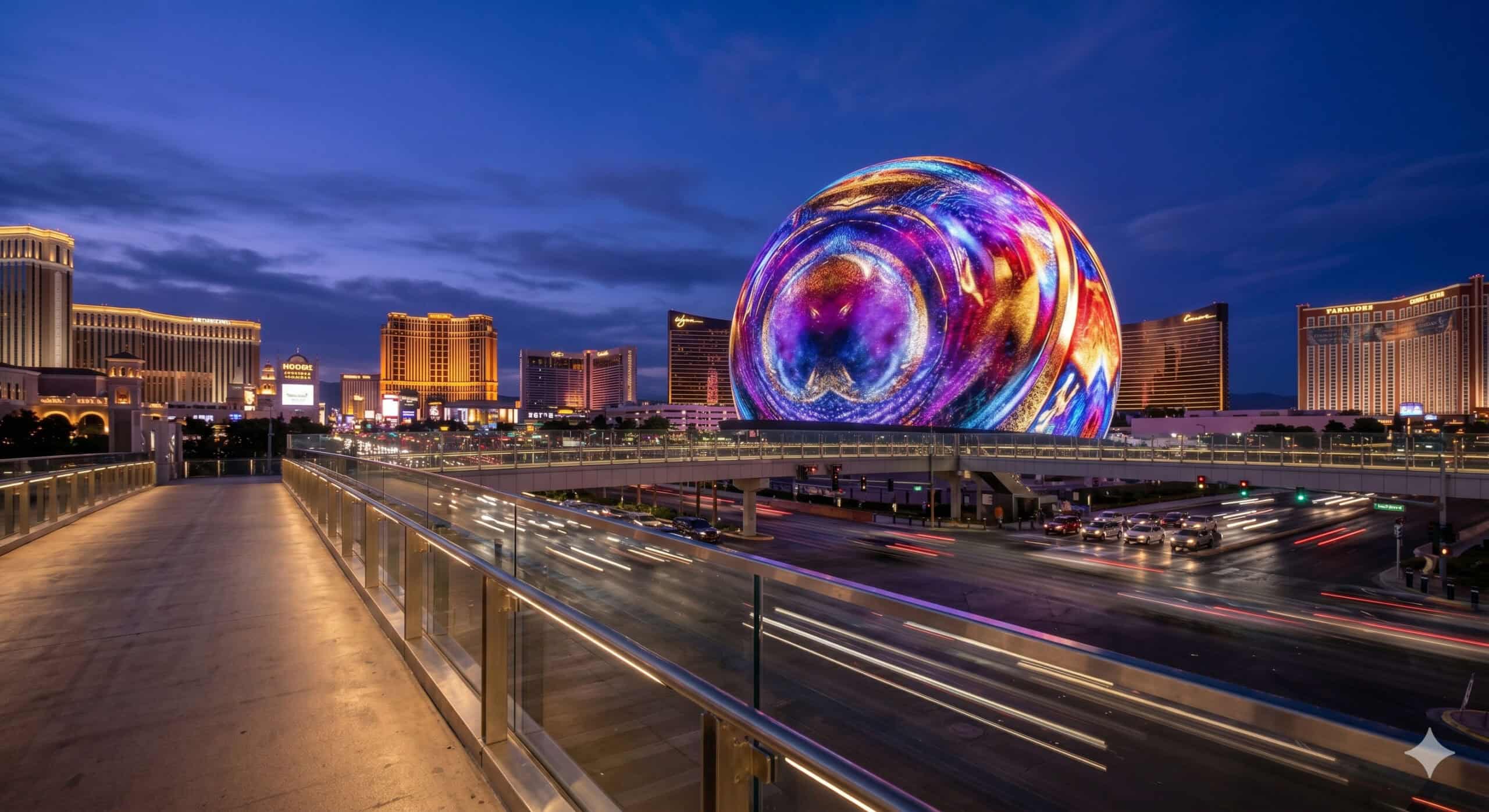
The Sphere stands 366 feet tall and stretches 516 feet wide — officially the world’s largest spherical structure. Its exterior, called the Exosphere, is covered in roughly 1.2 million programmable LED pucks capable of displaying virtually any image, video, or animation at a resolution that reads clearly from blocks away. For photographers, that means no two visits produce the same shot. On any given night the Sphere might be cycling through cosmic imagery, sports graphics, seasonal art, or brand content, each display creating a completely different visual mood.
During daylight, the structure rewards architectural photography on its own terms: the sheer geometry of the dome against the desert sky holds up well even when the LEDs are off. Come back after dark, and that same frame transforms into something closer to a large-scale light installation. The surface itself is the subject. Plan for both.
Best Spots to Photograph the Las Vegas Sphere
1. Pedestrian Bridge on Sands Avenue
The pedestrian overpass spanning Sands Avenue near the Venetian Expo Center is the spot serious Sphere photographers keep coming back to. Walking up the ramp puts you about 15 feet above street level, and from that elevation you can line up the Sphere against the sky with almost nothing competing on either side. Look southeast from the bridge deck and you’ll see the full spherical silhouette — top to bottom, edge to edge — without street signs, parked cars, or pedestrian clutter breaking the composition. Because you’re slightly above the surrounding streetscape, the Sphere appears to float. This works especially well at blue hour, when the fading sky wraps the structure in deep indigo. The bridge is a public pedestrian walkway with no gates or access restrictions, open at all hours.
2. Corner of Koval Lane and Sands Avenue
Walk about two blocks east from the Sphere along Sands Avenue, turn the corner at Koval Lane, and look back west-northwest. From this ground-level intersection you get something the pedestrian bridge can’t offer: foreground depth. The palm trees lining Sands Avenue create natural framing on either side, and if traffic is moving along Koval, light trails from passing vehicles add kinetic energy to long-exposure shots. This is also one of the few spots where you can set up a compact tripod on the sidewalk without blocking foot traffic. At night, with the LED display running at full brightness, the Sphere is bright enough to read by from this distance — your camera locks focus easily even in the dark.
3. Strip Sidewalk Near the Venetian and Palazzo
Standing on Las Vegas Boulevard in front of the Venetian or Palazzo and facing northeast gives you the classic establishing shot: the Sphere rising dramatically above and behind one of the Strip’s most elaborately decorated facades. The scale contrast here is something — Renaissance-inspired casino architecture in the foreground, a giant glowing orb in the sky behind it, and the constant motion of Strip crowds between you and it. Frame wide to get both subjects in the same shot, or zoom in to isolate where the Sphere’s curve meets the casino roofline. Evening is the prime window, both because the LED display is active and because the Venetian’s exterior lighting adds warmth to the foreground.
4. High Roller Observation Wheel
The High Roller at the LINQ Promenade stands 550 feet tall, which puts you well above the Sphere’s roofline at peak height. As your gondola climbs through the eastern arc of the wheel, the Sphere appears at roughly eye level and then slightly below — a perspective you simply cannot get from street level anywhere in Las Vegas. Because the gondola moves slowly and continuously, a single 30-minute ride gives you a wide sweep of viewing angles. This is the one vantage point where you can photograph the Sphere with the full Strip spreading out beneath it in both directions. Buy your ticket in advance to choose your boarding time and arrive 10 minutes early to position yourself in the gondola for the east-facing approach. Admission pricing changes seasonally — verify current rates on the High Roller website before you go.
5. East-Facing Strip Hotel Room Window
If you’re staying in a high-floor east-facing room at a Strip hotel between the Wynn and Caesars Palace, your window may be the best tripod platform in Las Vegas. Hotels including the Palazzo, Venetian Tower, and Wynn all have rooms with unobstructed views toward the Sphere from above street level. Check your room assignment at check-in and ask the front desk specifically for an east-facing high-floor room — staff at these properties hear that request regularly. Shooting with your lens pressed gently against clean glass minimizes reflections. From 20 or 30 floors up, the Sphere sits comfortably in the middle of a frame filled with the glittering grid of Las Vegas east of the Strip.
Best Time of Day to Photograph the Las Vegas Sphere
Blue hour is your best window by a clear margin. The Exosphere LED display activates at or just after sunset — typically between 8:00 and 9:00 p.m. in summer, closer to 6:00 to 7:00 p.m. in winter — and for roughly 20 to 40 minutes after that, the sky still holds a deep indigo that gives your images a second light source to balance against. The LED display pops without blowing out, and the sky retains gradients of blue and violet behind the structure. This is the window worth planning your whole evening around.
Golden hour — the 30 to 45 minutes before sunset — rewards architectural photography. Warm directional light rakes across the dome’s surface, revealing the texture of the LED panels and casting subtle shadows that add dimension. The Exosphere isn’t yet active at this point, so you’re working with form and structure rather than color and animation. Worth shooting. Just plan to stay through blue hour.
Full dark, once the sky goes completely black, gives you maximum LED drama. The Sphere is at its most visually arresting — colors punch hard and the contrast with the night sky is sharp. The tradeoff is that exposure becomes trickier; there’s nothing to balance the brightness of the display against, and highlights clip easily. Shoot RAW and bracket your exposures.
Midday is the least glamorous option, but it’s workable. Hard overhead sun is unflattering for most subjects, but the geometry of the Sphere holds up in flat light and the surrounding architecture reads cleanly. Use it if your schedule allows no other window.
Camera Settings for the Las Vegas Sphere
Smartphone Settings
At dusk and into the evening, switch Night Mode on and run it for your first few shots to get a baseline exposure. Then open your camera app’s Pro or Manual mode — available natively on modern iPhones as well as Samsung Galaxy and Pixel devices — and experiment with ISO between 800 and 1600, a shutter speed between 1/15s and 1/30s, and manual focus locked on the surface of the Sphere rather than the sky behind it. Tap the Sphere on your screen to set the exposure reference point; tap the sky instead and the display will blow out. For daytime shots, enable HDR and keep ISO at its base value (usually 50 on iPhones) for the cleanest files. A small travel tripod — the Joby GorillaPod 3K is compact and reliable — or a DJI OM 7 phone gimbal will eliminate the motion blur that kills Night Mode shots taken handheld.
Entry-Level DSLR and Mirrorless Settings
During daylight, Aperture Priority at f/8 with ISO 100 to 400 gives you the depth of field to keep both the Sphere and any foreground elements sharp, while letting the camera handle shutter speed. In most midday and golden-hour conditions you’ll land somewhere between 1/250s and 1/1000s — fast enough to handhold without blur.
At blue hour and into full dark, switch to Manual mode. Start with f/5.6 to f/8, ISO 800 to 3200 depending on how bright the display is running, and a shutter speed between 1/30s and 2 seconds. A tripod is not optional at this point — it’s essential. Use your camera’s 2-second self-timer or a wireless shutter remote to eliminate vibration from pressing the shutter button. If in-body stabilization or a stabilized lens is available, keep it on when handholding but switch it off once you’re on the tripod. The Sony a6400 paired with the 16–50mm kit lens is a capable lightweight option for this subject; Canon Rebel shooters with the 18–55mm STM are in a comparable spot. If you’ve moved up to something like the Sony a6700 or a full-frame body, you’ll appreciate the better high-ISO performance once the sky goes fully black. Shoot RAW whenever possible — the Sphere’s LED colors can shift in JPEG compression, and RAW files give you significantly more control over recovering highlight detail and correcting any color cast in post.
Best Angles and Compositions for Sphere Photography
Start with the wide establishing shot: the Sphere in full context within the Las Vegas skyline, enough surrounding environment that the scale registers right away. From any of the spots above, step back until the Sphere occupies roughly one-third of the vertical frame height — that proportion tends to feel both grand and informative rather than just large.
Then move in close. The surface texture of the Exosphere at full LED output is worth isolating: individual panels, color gradients shifting across the curve of the dome, the slight imperfections where geometry meets light. A 70mm or longer focal length from the Sands Avenue bridge or the Koval Lane corner lets you pull a detail shot that reads almost abstract.
Look for reflections in the glass facade panels along Las Vegas Boulevard. On evenings when the Sphere is running a colorful display, those tones bounce into the casino glass and create a secondary image that’s ghostly and luminous. Frame tightly on a single window panel to get the reflection filling the shot.
Put a person in the foreground. The Sphere’s scale is genuinely hard to communicate without a human element — a friend standing on the Sands Avenue sidewalk with the glowing dome behind them gives viewers an immediate reference point. Finally, use the Strip’s streetlights and palm tree medians as leading lines: position yourself so a row of lamps converges toward the Sphere in the background, pulling the eye exactly where you want it.
Gear Worth Packing for a Sphere Photo Session
You don’t need to overpack. A compact travel tripod — the Peak Design Travel Tripod or a Joby GorillaPod 3K — takes up almost no room in a carry-on and makes a real difference for every shot taken after sunset. For smartphone shooters, a clip-on wide-angle lens like the Moment 18mm Wide lets you capture the full structure from closer vantage points without backing into traffic. The DJI OM 7 phone gimbal is worth considering if you plan to shoot any video alongside your stills; it also helps significantly with long-exposure stills when a full tripod is inconvenient.
For interchangeable-lens shooters, the Sony a6400 or a6700 paired with the 16–50mm kit lens covers most Sphere photography effectively. The 16mm end handles wide establishing shots; the 50mm end brings enough reach for mid-range compositions. Canon Rebel SL3 with the 18–55mm STM is a comparable lightweight kit. If you own a longer prime — a 85mm or a 70–200mm zoom — toss it in the bag for LED texture shots from the pedestrian bridge. Pack a spare battery. Cold desert nights and extended blue-hour sessions drain a charge faster than expected.
Frequently Asked Questions About Photographing the Las Vegas Sphere
Can you photograph the Sphere for free?
Yes, completely. Every public outdoor vantage point in this guide — the Sands Avenue pedestrian bridge, the Koval Lane corner, and the Strip sidewalks — is freely accessible at all hours. You don’t need a ticket to the Sphere, a hotel room, or any paid admission to photograph the exterior. The only shooting spots that carry a cost are the High Roller observation wheel and a hotel room with a view.
What time does the Sphere light up?
The Exosphere typically activates at or just after local sunset, which ranges from around 5:30 p.m. in December to approximately 8:00 p.m. in June. The display generally runs until well past midnight. Exact activation times can shift depending on programming schedules and events inside the venue, so plan to arrive 20 to 30 minutes before local sunset to catch the full transition from off to on.
Are tripods allowed near the Sphere?
Compact travel tripods and GorillaPod-style flexible tripods are generally usable on public sidewalks and the pedestrian bridge without issues. Full-size studio tripods with wide spreader legs can create pedestrian obstruction and may draw attention from security in high-traffic areas. Keep your setup compact and be ready to step aside when foot traffic requires it. Inside MSG Sphere as a venue, tripod policies follow standard concert-venue rules and depend on the specific event.
Can you photograph inside the Sphere?
Personal photography is permitted inside MSG Sphere for most events, subject to each show’s individual policy. Dedicated cameras (DSLRs and mirrorless) may be restricted for certain performances — check the specific event’s entry policy before you go. Smartphones are generally allowed. The interior features the world’s largest LED screen, about 160,000 square feet of display surface curving overhead, which is itself worth photographing.
What is the best lens for photographing the Sphere?
A wide-angle to standard zoom covering roughly 16–50mm on an APS-C sensor (equivalent to 24–75mm full-frame) handles most Sphere photography effectively, getting you from wide establishing shots down to mid-range compositions. For detail and texture work on the LED surface, a 70–200mm zoom or a 50mm prime used from a distance gives enough reach to isolate individual sections of the dome. A fast prime in the f/1.8 to f/2.8 range is worth considering if low-light handheld shooting is a priority for your style.
Are drones allowed near the Las Vegas Sphere?
No. The Las Vegas Strip corridor falls within restricted FAA airspace, and drone flight near the Sphere is prohibited without specific authorization. The area is actively monitored, and unauthorized drone operation carries serious legal consequences. Stick to the ground-level and elevated vantage points covered in this guide — there’s more than enough to work with.
Go Beyond the Main Strip
The Sphere is a great starting point, but Las Vegas rewards photographers who wander off the obvious frame. Once you have your Sphere shots locked in, give yourself permission to explore. You’ll find compositions you never expected just a few blocks off the main boulevard. The secret photography spots in Las Vegas guide on this site will take you somewhere the tour buses never stop. Happy shooting.